Sunday, 29 March 2015

”We will bleed France white” Von Falkenhayn's strategy for Verdun

Latest batch of Poilus for the front.
Minis are all from Forgotten & Glorious.

The past week saw me continuing the preparatory work for our Verdun 1916 project, as the Voie Sacrée of my painting table produced some fresh Poilus reinforcements, in the form of the wonderful WW1 French from Paris-based Forgotten & Glorious Miniatures. 

No Man's Land can be an unwelcoming business.
British infantry goes over the top - this time with air support.

Meanwhile, a club event also offered me a chance to arrange and photo the beautiful trench terrain we’ll be using for the project. All the terrain boards were scratch build by fellow club member, Nils. Pictures of these impressive boards can be found throughout this blog post.

Close Up of the Poilus.
The Forgotten & Glorious sculpts are really amazing to paint.

In my research on the battle of Verdun, I’ve found a new “friend” – Audible.com.
This Amazon service offers historic audiobooks in abundance, and many classics as well as new titles on the Great War. So far, I’ve been painting miniatures while listening to “The Guns of August” by Barbara W. Tuchman and “A World Undone: The Story of the Great War, 1914-1918” by G. J. Meyer. They both offered around 30 hrs of superb entertainment, consumed with the appropriate period miniatures and a brush in my hand. But let’s leave the cosy comfort of the hobby table and go back in time to the cold, muddy February of 1916 at Verdun.

Germans coming out of their underground "Stollen" shelters to receive the enemy.

Von Falkenhayn and the German plan of attack:

Born on 9/11 in 1861, Erich von Falkenhayn was a coolheaded and pragmatic man with more than 30 years experience in the officer ranks of the Imperial German army. He was favoured by the Kaiser, and thus became a natural rival to the Hindenburg-Ludendorff branch of the army. On the contrary to Hindenburg, von Falkenhayn believed that the war would be won on the Western Front, and thus in his role as Chief of General Staff, preferred a strategy of limited engagement on the Eastern Front, while pushing any reserves into the Western theatre.

Erich von Falkenhayn.
Chief of the General Staff until Verdun proved a failure.


Von Falkenhayn had replaced von Moltke in 1914, when the latter’s health failed him due to stress after the defeat at the Marne, and consequent failure of the Schlieffen Plan. When assuming office, von Falkenhayn had the fresh offensives of August 1914 as available data, on which to base his strategy. He would see Germany through the difficult transition of mentally and strategically converting the outlook from a quick summer war, to the long war perspective. His key to success: Attrition.

An aerial view of the German trench lines.

1915 had seen the Western Front settle into a static war, fought from trenches, and with artillery, machine guns being joined by new terrible weapons like gas and flamethrowers. Army Commanders on both sides struggled to adopt strategies that would be prove even limitedly fruitful in this new scenario of war. 

The Forgotten & Glorious minis come with a variety of heads and arms,
offering good animation in the ranks.

Von Falkenhayn had his own unique approach. His idea was to find a spot of great moral importance to the French, hit them there and thus goat the French into expensive counter attacks at well-prepared German positions, drawing the French into an downward spiral of manpower attrition – a sophisticated phrasing for what was in effect slaughter. In his own words he would “Bleed France white”.

The British trench left nearly empty as the Tommies go over the top.

In preparation for the attack, von Falkenhayn had massed around 1.200 guns at Verdun, while the busy German engineers had built 10 new rail lines into the back country, with 20 stations as drop of points for reinforcements. The improved rail-logistics would offer the German artillery an average of 33 munitions trains per day during the battle, equalling a constant flow of some 2.000.000 shells to the hungry guns. In addition several thousand km of telephone cables were laid in the Verdun area, to guarantee communications would flow uninterrupted as the fighting commenced. 

Caught in the wire.

For the 5th Army, who was to undertake the attack, huge catacomb-like “stollen” (underground shelters) were dug, some of them up to 14 meters deep and each accommodating 1.000+ men. Thus the scene was set to create Hell on Earth.

A forward German machine gun position greets the visitors.

The attack started on the morning of February 21st 1916 by a colossal 1.000.000 shell “trommelfeuer” – an artillery barrage of such intensity that the explosion of each individual shell just merged into the sound of the next, becoming an indistinguishable rumble. This apocalyptic phenomenon was heard some 160 km away. 

To be continued - Thank you very much for reading!

Wednesday, 18 March 2015

SMS Seydlitz – The Shell Magnet

The SMS Seydlitz in 1/2400.

Named after one of Prussia’s greatest cavalry generals of all times, the SMS Seydlitz had quite a name to live up to. Contributing in no small amount at all mayor actions on the North Sea from Heligoland, Dogger Bank and to the turbulent Battle of Jutland, she was however going to live up to the named legacy of dash and tenacity in every way. 

The Seydlitz looking her finest for a WW1 commemorative postcard. 

More modern than her battle cruiser predecessors Von der Tann and the two ships in the Moltke-class, the SMS Seydlitz saw the introduction of a new innovative propulsion system allowing an improvement in armor without any loss of speed. The new layout of her propulsion system, would give her 63.000 shp, no less than 21.000 shp more than Von der Tann. 

Aerial photo, the white circles would help pilots set her apart from any entente ships.

This increased power needs to be considered off set against the increase in armor, with the SMS Seydlitz getting a belt armor of 11 inches compared to Von der Tann’s of only 9.5 inches. The effective cruise speed of the boat was the same as the rest of the High Seas Fleet’s battle cruiser force – with a max output of about 28 knots. With these innovations, she was laid down for construction at the Krupp subsidiary; Blohm & Voss in Hamburg in 1911.

Seydlitz steaming out to sea.

With fate having a severe beating in store for the SMS Seydlitz, this heavy armored but fast moving beauty was going to need all the nickel-refined steel plate protection she could get from the Krupp works at Essen. Leading at the front of Hipper’s force at Dogger Bank in 1915, the SMS Seydlitz was going to take some critical, but very instructive damage. 

Barely noticeable, but I tried to add the Seydlitz ship crest,
 with three red fish on a white shield.

A critical hit scored on the SMS Seydlitz by fire from Tiger and Lion, almost blew up the ship, as internal flash from a penetrating shell, was traveling down towards the main magazines. An alert German officer ordered the magazines flooded, and the damage was contained to the reloading chamber, which however blew up killing 159 men. This important learning point would result in an important anti-flash updating of German ammunition and cordite practice, which would prove to be crucial at Jutland.

The Seydlitz barely afloat, limping home after Jutland.


At the Battle of Jutland, the SMS Seydlitz was initially locked in a duel with the Queen Mary in the late afternoon, resulting in a penetrating shell causing an internal explosion ripping the latter ship in two. With terrible consequences, the tables had now turned, and it was the British battle cruisers, which were being schooled in how to handle cordite and contain flash from explosions.

In dock after Jutland, waiting for repairs. 
Notice the large torpedo damage to her starboard side.

 During the later engagement with Beatty and finally the epic showdown with Jellicoe, the Seydlitz was in all hit 21(!) times by heavy shells, and even torpedoed. When she limped back towards home during the night after the battle, she carried an extra 5.300 tons of water due to flooding, with her deck barely remaining above the waterline. As her crew prepared to abandon her, two pump boats from Wilhelmshaven came out to stabilize and bring her home for repairs. Like her historic namesake, the Seydlitz had refined the German forces, been at the heart of the battle, bore the brunt of the charge, and taken a beating to write home about.

Technical drawing of the SMS Seydlitz.


SHIP DATA:

Laid Down: Feb 1911

Launched: Mar 1912

Completed: May 1913

Constructed at: Blohm & Voss, Hamburg

Displacement: 24.988 tons (Full load)

Dimensions: 658ft x 94ft x 30.5ft

Main guns: 10 x 11inch

Armor: 12in belt, 3.1in deck and 9.8in turret armor

Machinery: Parsons Turbines creating 63.000 shp 

Speed: 28 knots

Endurance: 4.200 miles at 14 knots


Thank you very much for reading!

Thursday, 12 March 2015

"My blood belongs to the Emperor" - General Lasalle

Lasalle with his pipe.
The figure is from Front Rank.

For this week’s blog post I’m leaving the trenches of Verdun, traveling only a short distance east to Metz, the birthplace of the legendary “Hussar General” – Lasalle.

Early Life

Born on May 10th 1775 into a family of minor nobility, Antoine-Charles-Louis showed a flair for the military trade from an early age. Already at 14 he had joined the local regiment and merited a rank of Second Lieutenant. 

Lasalle leading the 5th into battle.

When the Revolution threw France into turmoil, Lasalle was in 1792 stripped of command due to the idealistic view of the revolutionaries, wanting to wash out all the old aristocratic officers. Lasalle was however not deterred, and took this setback with great calm. He moved to Paris and enlisted in the revolutionary army as a private.


Campaign in Italy

In 1793 Lasalle joined the Army of the North on its campaign in Italy, and his conduct soon earned him advancement in the ranks. He was present at the Battle of Rivoli, where he proved to be beyond fearless, charging down and breaking an complete Austrian regiment with only 26 chasseurs at his side. The Italian campaign thus saw Lasalle’s star rise, and Napoleon personally asked the young cavalry officer to join him for the Invasion of Egypt in 1798.

Lasalle smoking his pipe.


The Invasion of Egypt

At the Battle of the Pyramids Lasalle made yet another daring charge, storming a garrisoned village at the head of no more than 60 horsemen. The wild charge bore home, and Lasalle continued his advance down an unknown path amongst the Giza Pyramids, offering him an opportunity to cut off the enemy, and serving them on a plate to Napoleon. Greatly impressed, Napoleon promoted Lasalle to Lieutenant Colonel of the 22nd Horse Chasseurs and the 7th Hussars.

Lasalle at the head of his brigade.

Lasalle would soon repay Napoleon for this advancement, when he saved the life of Davout. The General had been cornered by mamulukes at the Battle of Remedieh and was about to be cut down, when Lasalle dashed in, chopped both hands off the mameluke in front of Davout, broke his own sword over the head of Osman Bey, but kept on fighting by picking up swords and guns from the battlefield around him. The mamelukes eventually broke, and Lasalle had once again proven to have a cool head in the heat of action.


The Libertine Lasalle

Lasalle’s passions extended further than the battlefield. He consumed life in great breaths, or should I say in big gulps. A true light cavalryman he founded the “Society of Alcoholics”. Reputedly Lasalle drank, swore and was quite the libertine. After a night of heavy drinking, Lasalle proudly asked Paul Thiébault to count all the empty wine bottles. Thiébault remarked: “Do you want to kill yourself”? Lasalle answered: “My friend, any hussar who is not dead by thirty is a blackguard”

The libertine in a quiet moment of reflection.

No stranger to the passions of the flesh either, Lasalle had a long standing affair with Minister of War, Berthier’s wife Joséphine. When Berthier finally had enough and divorced Joséphine, Lasalle was quick to propose to her. To help out with the costs for the wedding, Napoleon gave 200.000 Francs to Lasalle. When the two men met up only a week after, Napoleon was keen to know how the planning was coming along. Lasalle remarked that he had spent the money on old debt and the rest he had gambled.

A view at the sabretasche and the dolman.

Normally this kind of insolence would have seen any other soldier stripped from rank and scorned, but Napoleon simply gave Lasalle another 200.000 Francs, and told him to get on with it. When Napoleon’s astonished staff asked why this Lasalle got such a soft treatment, Napoleon quietly answered: “It only takes a stroke of a pen to create a prefect, but it takes twenty years to make a Lasalle".


The “Brigade Infernale”

At the famous battle of Austerlitz, Lasalle won the admiration of Murat, who then put him in command of a Light Cavalry Brigade consisting of the 5th and 7th Hussars. Under the leadership of Lasalle, this brigade would become known to history as The Hellish Brigade – Brigade Infernale.

Detail: Lasalle raising his pipe signaling the charge. 

At the Battle of Jena, Lasalle and his brigade captured the King of Prussia’s bodyguard, and pursued the Prince of Hohenlohe off the battlefield at sword’s point. Later during the Prussian campaign, Lasalle and his small contingent of hussars reached the fortified city of Stettin. The well defended city had a garrison of 5.000 men and 281 guns, but Lasalle calmly demanded their surrender stating: “If, by 8 a.m. you have not surrendered, the town will be bombarded by our artillery, stormed by 50,000 men, the garrison will be put to the sword and the town will be plundered during twenty-four hours"

The commander of Stetting believed the message from Lasalle, and surrendered his entire force to the little group of French cavalrymen. This feat made Lasalle more famous than ever, and upon hearing of the city’s surrender, Napoleon wrote to Murat: "If your Light Cavalry captures fortified towns, I’ll have to discharge my Engineer Corps and have my heavy artillery melted down"

Lasalle punishing his brigade at Golymin.

But Lasalle could be brisk as well as dashing. During the Battle of Golymin, the Hellish Brigade was charging a battery of 15 Russian guns. As they closed in on the enemy the fire on the horsemen intensified. A big portion of the brigade broke, and they fled to the rear. The furious Lasalle spurred his horse and pursued his fleeing men. Catching up with them he screamed “Halt!” - the men obeyed their enraged commander and stopped their wild stampede. Lasalle quietly brought the brigade back to the front line, positioned it across from the Russian guns, and told them to hold ground. Lasalle rode forward to a position 20 paces in front of his men, and calmly took the murderous fire from the Russian battery. The brigade accepted this punishment with no further disobedience. 


The final battle and immortality

On July 5th 1809, Lasalle fought what was to be his last battle at Wagram.
On the morning of the battle he had a strange feeling, that the fight before him might be his last. When he opened his baggage he found his pipe broken and a wine glass that his wife used to be crushed. The passionate Lasalle read this as an omen of death to come.
He then wrote two letters, one to the Emperor and one to his wife.

The final charge.

Later during the battle of Wagram, while charging at the head of the 1st Cuirassiers, Lasalle was shot between the eyes, dying instantly. The farewell letter to his wife became famous. The last part of it reads: “"Mon coeur est à toi, mon sang à l'Empereur, ma vie à l'honneur" (My heart belongs to you, my blood to the Emperor, my life to honor)

The dashing libertine general had almost kept his word. He died 34 years old.


Thank you very much for reading!

Friday, 6 March 2015

Poilus! – Verdun 1916

First batch of skirmish-based Poilus.
The minis are from the wonderful "Forgotten & Glorious" 28mm range.

In some aspects I hesitate to even write about this battle out of pure respect.
But then I remind myself, that there is a generation now, which needs to apprehend and value the lessons inherent in true catastrophes like Verdun.

How do we teach our children, that human life can be so utterly stripped of meaning and consumed by violence? I find it hard, but I also know that it’s important. It’s the road to not making the same mistakes twice.

Young men became veterans.

Ever since I first read about the Great War as a teenager, I’ve been drawn by this epic battle, and to understanding the legend of the “generation sacrifié”. When working a short summer job in Strasbourg at the age of 19, I took my car one weekend, and drove over to see the actual place. I still recall the discomforting feeling in the air, not lost on a Danish teenager about the same age then as many of the 900.000 dead, who’s bones lay buried in the field below. I saw the collapsed trenches, where you still today see rusty bayonets sticking up through the ground, marking the resting place of men buried alive. It was as if it the place itself was one big scar. 

View towards the Douaumont memorial.
Inside the bones of 130.000 unknown dead are stacked. 

Next year we mark the centennial of Verdun, the longest and bloodiest of all the battles in the Great War. With that occasion in mind, I’ve set out together with a few club members here in Stockholm, to paint up a suitable skirmish based collection in 28mm. The goal is to run a series of scenarios from the almost 10 months long battle. There will be plenty of visual candy coming up, as I’m going to photo the impressive trench-terrain club member Nils have made. Look out for that soon.

Close-up on three Poilus - the FG Minis are in my opinion 
the best WW1 French available out there.


VERDUN - BACKGROUND

The name Verdun rings out with importance in history, all the way down to the Romans.
First mentioned during the conquest of Gaul as “Verodunum” (meaning: Strong Fortress), Verdun had a DNA of military significance right from the start. After Roman control of Europe faltered, none other than Atilla the Hun later sacked the city. But, it was during the Frankish era, that Verdun would start to become a symbol of Franco-German rivalry. The sons of Charlemagne meet here in Verdun, to devide their fathers empire into what would later be France to the west, and to a large extend what was the Holy Roman Empire to the east.

The “Generation Sacrifié”
The Battle of Verdun lasted almost 10 months, 
and demanded close to 900.000 casualties.

It was here at Verdun, that the French master architect of defensive fortresses, Vauban, build his line of defence, to bolster and strengthen the conquests of Louis XIV. It was Verdun that became the last French fortress to surrender during the initial campaign of the Franco-Prussian War of 1870, and it was Verdun to which France anchored it’s hope once again in 1914. 

A view on the back - equipment and the iconic buttoned-up long coat.
Boots and socks touched up with earth pigment.

In 1916 Joffre had robbed the place of any real defensive artillery, and one could argue the actual strategic importance of Verdun. But, the morale of a people is a tricky size altogether, building on pillars of national symbols and subjective feelings, not always in line with what is militarily practical or even strategically sound. After the initial battles of 1914, acting as an anchor in the French line as the Battle of the Marne played out, Verdun had in many ways become just that. A symbol of France’s ability to hold on, to stand it’s ground.

Poilus getting ready for the charge.

German commander Erich von Falkenhayn, had counted on just that symbolic value, when he planned to strike at Verdun in 1916. His direct tactical dispositions were not made to conquer Verdun, but rather to draw the French army into a mass slaughter. In effect he wanted to “Bleeding France White” as he himself put it. In February 1916 the massive German onslaught would set in.

To be continued – Thank you very much for reading!

Wednesday, 25 February 2015

Danes in Pickelhauben - Early WW1 Infantry

The 84th Inf Reg "von Mannstein" from Schleswig advancing.
Miniatures from Great War Miniatures.
These are the two first squads of a four-base company.

This week I refocused my imagination from the brisk waves on the North Sea and the Battle of Jutland 1916, to the dusty roads of Belgium and the summer heat of august 1914. It was finally time to get started with my Early World War One project. 

Danes in German service.
The signs reads (in Danish): "The North-Schleswigs send a greeting"

As few of my regular readers have escaped, I grew up in Jutland. Again this coincides with my WW1 projects. This time, I wanted to focus on the 30.000 Danes from Southern Jutland, who served as part of the Kaiser’s army from 1866-1919. 
“What – Danes in the Kaiser’s army ?” you say… Well, yes – here is the story:

The Danish border before 1864, and after 1864. Schleswig and Holstein was duchies under the Danish Crown. On the right side map, the orange line illustrates the border 
that was drawn in 1920, after the fall of Imperial Germany.

In 1864 Bismarck launched a German coalition army, under the leadership of Prussian Field Marshal Von Moltke, into a war against Denmark over the hotly disputed duchies of Holstein and Schleswig. Both provinces had a mix of Danish and German speaking citizens, but especially in the region of Schleswig this was very visible with the southern part predominantly German and the northern part to a large extend Danish in both language and culture.

Another shot at the two squads advancing.
I've based them on 50*50mm bases. 4 such bases will constitute a company.

The result of the War of 1864, was a crushing defeat for the small Danish army, as their dreams of national greatness spurred by the successes from the war of 1848, was shot to pieces and buried at Dybbøl by superior German rifles and hundreds of heavy guns from Krupp. This was the first careful step toward German unification, the legacy and life’s work of Bismarck.


Imperial Germany - forged by Bismarck and rules by the Kaiser.

The peace settlement was a bitter pill for the Danish government. With the army in ruins and practically no real political allies to add counterweight to the diplomatic game, the Danes had to cede both duchies to Prussia and the North German Coalition. This meant, that northern Schleswig (or Southern Jutland if you will), with a predominantly Danish population, came under the rule of Berlin. 

Danish speaking "North-Schleswig" troops before departure to the front.

The Danes quickly got equipped with Needle-guns, “pickelhauben” and enrolled into the dark blue uniform. Many new regiments was formed from the newly conquered territories, amongst them the 84th Infantry Regiment “Von Mannstein”, located at Haderslev (Today a garrison city in southern Denmark) The regiment was heavily involved in the Franco-Prussian War, and took part in big battles like Gravelotte-St-Privat and Le Mans. Like Denmark, France would also suffer defeat by the German arms, and in 1871 the German states were united under the leadership of the Prussian King, proclaimed Kaiser in the Hall of Mirrors in Versailles. Bismarck’s work was complete.

View from behind, as the line advances.
When they came close to the enemy receiving fire, they would disperse into smaller squad sized units.

But for the Danes of Northern Schleswig, the hardship had just begun. Now part of the German Empire, ruled by a Kaiser, they were dressed in grey and drafted into the professional and effective mobilization machinery of the German state. As the First World War erupted, the 84th was attached to 18th Division, part of Von Kluck’s 1. Army, scheduled to go wide and be the hard hitting right flank of Von Schlieffen’s plan. 

German infantry advancing on the Western Front - August 1914.

The Danes of the 84th fought with distinction at the Battle of Liége, Charleroi, Mons, The Marne and later at the Aisne. By the end of September, these young men had been turned into battle hardened veterans. They would fight on for the next four years, enduring the horrors of the trenches, the gas, the heavy shelling and the endless mud. Of the 30.000 Danes enlisted under the Kaiser, 6.000 was killed in action. Danes served at both the Western and Eastern Front and in the Kaiserliche Kriegsmarine.

Close-Up: The helmet cloths carried the regimental no. in red or green.

As a further anecdote to the above, I can mention that during my time as drafted into the special chemical war branch of the Danish Army, I was stationed at the same garrison city as the Danes in the 84th – in the now Danish city of Haderslev.

The defeat of Imperial Germany again raised the question of Schleswig.
This map shows how Schleswig was divided between Germany and Denmark, after a plebiscite in 1920.

South Jutland was returned to Denmark in 1920. As part of the post WW1 peace settlement, the North Schleswig region had a plebiscite, which finally settled the matter and drew the border we live by today. The region holds a duo-cultural profile, harmonized and fully integrated in modern day Europe.

Thank you very much for reading

Tuesday, 17 February 2015

The SMS König: A 10-gun broadside

The SMS König with Rear Admiral Behncke taking the van position at Jutland.
Model is from the 1/2400 Micronauts range by GHQ.

Borrowing the internal layout of the previous Kaiser Class, but with improved broadside factor matching that of the contemporary British Iron Duke class, the König class battleship program was approved by the Kaiser as part of the 1909-10 naval budget. The class would comprise four ships: König, Grosser Kurfürst, Markgraf and Kronprinz – all fitted and launched during 1914, making them the newest ships in the German navy at the outbreak of the war.

The SMS König enjoying a quiet day at sea.

The König class would retain the use of the 12in Krupp guns, offering a higher muzzle velocity but also increased barrel wear. The British navy had at this time already shifted to 13.5in or even 14in guns for their ships, with the improved shoot that would potentially come as an effect of lower muzzle velocity. The German navy would keep their faith in the 12in all the way until the launch of the Bayern class in 1916, fitting that class with whopping 15in guns.

Horizontal photo of the model.
Note the elevated masts,

In terms of armor, the König class stood it’s ground towards the opposing British ships both in belt and deck armor. Comparing to the Kaiser class, the significant improvement was to scrap the clumsy layout of the mid-ship turrets of the Kaiser class, and replacing this with a superimposed central turret on the new König class. With this mid-ship turret being able to rotate to both sides, the König was the first ship class able to direct a 10-gun broadside towards the enemy. 

Extending the masts.
I'm adding a small "T" etched in brass. 

The crisply detailed GHQ models take nicely to washes and highlighting.
Here the rust effects on the protective mine-skirts gets a light brown highlighting.

A good way to get a 3D effect when looking down on the deck,
is by picking out all the grey edges with a light grey.

Just like the grey hull, the tan colored deck also gets a 
highlighted edge to really create contrast and visual effect.

A final touch is applied to the dark sea green, by adding a layer of glossy varnish on top. 
This will create both depth and a realistic water effect.

Named in honor of King William II of Württemberg, the SMS König joined the High Seas Fleet as part of Battle Squadron III in 1914. In 1916 at the Battle of Jutland the SMS König, under Rear Admiral Paul Behncke, had van position as Battle Squadron III approached the Grand Fleet. When the two navies closed in she became heavily involved in a gunnery duel with Beatty’s Lion and later with the bigger British battleships Barham and Warspite of the 5th Battle Squadron. 

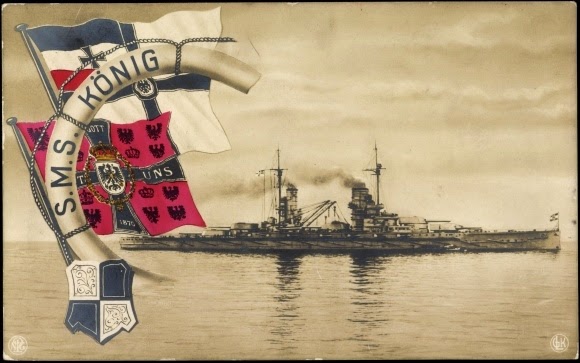
Actual WW1 postcard with the SMS König.

After this first graze with Beatty and as the afternoon went into evenings, the König closed with the Iron Duke, the British flagship with Admiral Sir John Jellicoe on-board. The König started to come under fire from the larger 13.5in guns of the Iron Duke. One shell struck the forward conning tower, but didn’t penetrate. However, Behncke was injured but refused to leave the bridge and stayed in command of his ship during the rest of the battle.

The SMS König model, with full steam ahead on the North Sea.

In 1917 the König was again in action, but this time against the Russian navy at the engagement of Moon Sound. Here the König scored 9 hits on the Russian pre-dreanought Slava, eventually forcing the Russian crew to scuttle their ship. The operation was tied to the recent German conquest of Riga, and had the strategic aim to clear out the remnants of Russian naval forces in the area. 

A view from above.  I always apply name tags to the bases. Not only does it help with fast identification during games, but it also looks nice and adds to the finished model.

The last action of the SMS König was in 1918, and turned into nothing less than mutiny. With the Great War coming to a close, Scheer and the German admiralty wanted to strike a hard blow at the British Grand Fleet in the hopes of improving Germany’s position at the coming peace negotiations. In full disregard of the obvious peril and undoubted cost in men and material this operation would cause, Scheer ordered the Germany navy out to sea on the 29th October 1918. The order for a virtual suicide mission was to much for the hard tested sailors. Mutiny spread like a wildfire from ship to ship. Onboard the König, the Captain was wounded while both the first officer and adjutant was killed during the turmoil. 

The SMS König was finally surrendered and interned at Scapa Flow, where her crew scuttled her in June 1919. Today she rests at 40 meters depth and has become a popular diving site for enthusiasts.


SHIP DATA:

Laid Down: Oct 1911

Launched: Mar 1913

Completed: Aug 1914

Constructed at: Wilhelmshaven

Displacement: 28.148 tons (Full load)

Dimensions: 580ft x 97ft x 28ft 6in

Main guns: 10 x 12in 50cal (5 turrets)

Armor: 14-10in belt, 4,5in deck and 14in turret armor

Machinery: 3-shaft Parsons Turbines creating 31.000 shp 

Speed: 21 knots

Endurance: 10.000 miles at 10 knots


Thank you very much for reading