Sunday, 10 May 2015

Charles XII and his Dalecarlians

Charles XII leading his Dalecarlians into battle.
All minis and flag from Warfare Miniatures.

This week I finished up the C-In-C command base for the Swedish army we’ll be fielding at next weekend’s Lincon gaming convention in Linköping Sweden. As we are hosting a Great Northern War participation game based on the Battle of Holowczyn 1708, I thought it would be appropriate choosing a scene from that dramatic fight as inspiration. 

Another great Cederström painting of Charles XII.
The warrior king always wore a simple, dark blue "Karoliner" uniform into battle.

The Swedish warrior king, Charles XII, had a taste for battle and enjoyed leading from the very front, sword in hand. During the Battle of Holowczyn, he personally led three battalions of his Guard and the Dalecarlian Regiment over the Vabitsch River and into an initial flanking sneak attack on the Russian camp.

Portrait of Charles XII.
Took inspiration here when adopting a similar hairline to the miniature.

This dramatic scene is what I’ve tried to capture here, on the C-in-C base. King Charles XII, pointing with his sword, directing men from the Dalecarlian regiment forward into the fight. Currently there is no really good Charles XII miniature available in 28mm, so I built this one out of parts from three different Warfare minis, filing away the hairline on the head to resemble Charles’ actual hairstyle.

A view from the opposite site, showing the conversion I did
to create a Charles XII miniature.

To add a little drama and further allude to Charles’ special relationship with his Dalecarlians, I’ve posed him here waving the Dalecarlian regimental flag, as he takes a gallant stand at the front line.

The special relationship between the Swedish kings and the Dalecarlian people has deep roots, going all the way back to when Gustav Vasa founded the Swedish Crown with the help and encouragement of the Dalecarlians in the 16th Century. Through the ages of the Swedish warrior kings and imperial expansion, the tenacious and proud people of the hilly woods and lush farmland in Dalecarlia have been the indicator of national spirit, whether it was for or against the king and his wars.

Gustav Vasa addressing the Dalecarlians in Mora, 
leading to the rebellion that would finally overthrow foreign suppression, 
and found the Swedish Crown in the 16th century.

This special position, perhaps at the very heart of all things Swedish, naturally reflected on the morale and fighting spirit of the Dalecarlian Regiment. This infantry unit was a personal favourite of Charles XII, and often given the most dangerous and demanding tasks in a given battle – simply because the king trusted the Dalecarlians to get the job done.

The beautiful and picturesque Dalecarlia region.

Holowczyn was no exception, and the Dalecarlians preformed the risky sneak attack with great discipline and vigor, resulting in the Swedish forces shocking their adversaries and gaining the upper hand and initiative for the rest of the battle.

A view from behind, offering a good look at the Swedish "Karpus".
The special soft felt hat, worn by many Swedish units during the Great Northern War.
The Karpus could be bent down over the ears, as protection during the cold northern winters.

One year later at the Battle of Poltava in 1709, the Dalecarlians would once again be dealt a most dangerous and demanding task. They were to form the spearhead of an suicidal attack on a well defended Russian redoubt system. Having been given a clear order to attack and conquer the redoubts, the regimental commander, Roos, ordered attack upon fruitless attack, until the regiment was canistered to pieces and all but annihilated. 

Swedish troops storming the Russian redoubts at Poltava.

The destruction of the Dalecarlian regiment and the monumental Swedish defeat at Poltava would also signal the fall of the Swedish Empire, and the rise of a new one. The Russian Empire under Tsar Peter I.

Thank you very much for reading!
P.S: Did I mention my fiancé is from Dalecarlia ;0)

Sunday, 3 May 2015

Repnin's Grenadiers

Repnin's Grenadiers in a desperate fight against the 
well disciplined Swedish attackers. Models and flag from Warfare Miniatures.

Work continues on our club project for the Battle of Holowzcyn and the Great Northern War. This week’s output from the painting desk is a key Russian infantry unit, Repnin’s Grenadiers, participating in both Holowzcyn and the more famous Battle of Poltava. For those of you in possession of Osprey’s great book on Poltava, info on both Holowzcyn and this unit can be found in that volume.

The Uniform plate from which I took inspiration.

The unit is built using models from Warfare Miniature’s coming Great Northern War Russian range. These have not yet been released, but since we’re doing a rather large club project on Holowzcyn for the coming Lincon Gaming Convention, May 14-17th here in Sweden, Barry Hilton from Warfare Miniatures was kind enough to sell us a few spins from his master moulds. 

The mounted officer is trying to induce discipline into the line of grenadiers,
as they face a fierce "Gå På" doctrine charge by the Swedes.

Prince Repnin is an interesting character, and worth a few lines in his own right.
Anikita Repnin (Аникита Иванович Репнин) was born into a Russian noble family, and his friendship with Pater I would result in a career trajectory taking him to the rank of field marshal and in receival of a prince title.

Prince Anikita Repnin - 1668 to 1726.

At the age of 16 Repnin came in contact with Peter for the first time, as he was assigned to the only eleven years old future Tsar as his footman. Peter enjoyed Repnin’s company, and two years later, promoted Repnin to “Officer of the Playbuddy Battalion”.

The Streltsy - a conservative force in the face of Peter I's many innovations.

During the Streltsy Revolt in 1689, which was a reaction from the conservative forces against Peter’s many innovations to “westernize” Russia, Repnin was by Peter’s side as they took refuge in the Trotsky Convent. At this pint a strong friendship had developed, and after they both took part in the campaign against Azov, Peter promoted Repnin to the rank of General.

Executions at the Red Square during the Streltsy Revolt in 1689.

With the outbreak of the Great Northern War, Repnin was sent to the Baltics with 19 infantry regiments to honor the alliance with Poland-Saxony and August II. Repnin’s forces participated in the battle of Düna (Daugava), in which the Russian troops fought like lions, but were next to annihilated because they refused to surrender. 

In his effort to reduce the Streltsy Revolt, 
Tsar Peter took to refined methods of torture and mass executions.

After Düna, Repnin even took part in the battles of Nöteborg, Nyenskans and Narva, but it was in 1708 at Holowzcyn where his soldier-luck would run out. The overwhelming routing of his troops and his failure to stem the Swedish tide during the battle had enrage the Tsar. Peter court marshalled Repnin, and stripped him of all titles, demoting him to the rank of private in the army.

The Battle of Düna in 1701. 
The Russian force was next to annihilated as they refused to surrender.

The loyal Repnin took this standing up, and actually fought as a private in the subsequent Battle of Lesnaya in 1708. His colleague, General Golitsin, appealed to the Tsar, highlighting Repnin for promotion and the Tsar’s forgiveness. Peter eventually gave in, and reinstated Repnin with all his titles.

The order of Saint Andrew.

During the Battle of Poltava the following year, Repnin commanded the Russian center with excellence, and was awarded the Order of Saint Andrew. In 1726, after Russia’s main enemy for Baltic domination, Sweden, had been effectively beaten, Repnin died in the conquered town of Riga, having been promoted to Field Marshal the year before.

Thank you very much for reading!

Saturday, 25 April 2015

Field Marshal Carl Gustaf Rehnskiöld

Field Marshal Rehnskiöld personally lead 
decisive cavalry charges in many of Charles XII's battles.

Our local wargaming club, Little Wars Stockholm, is participating in this year’s Lincon gaming convention in Linköping. We’re hosting a participation table with scenarios from the Battle of Holowczyn 1708 – one of the Swedish army’s finest victories, and one of the more interesting battles from The Great Northern War.

Carl Gustaf Rehnskiöld.
1651 - 1722.

Holowczyn was fought between the Royal Swedish Army and the Tsar’s Russian Army under leadership of Prince Repnin, and was part of the Swedish ”march on Moscow”, that ended with a detour into Ukraine and the fateful defeat of the Swedish army at Poltava about a year after Holowczyn. 

But in 1708, things were still looking bright, and the young Charles XII was the dashing warrior king, admired by the courts of Europe and who’s courage was praised by Voltaire in his great work on the Swedish king. But, to become a successful warrior king, you need some good generals.

The Swedish victory at Narva 1700.

One of Sweden’s finest cavalry officers was Carl Gustaf Rehnskiöld, who started his career under Charles XII’s father back in the 1670ies, during the Scanian War. Rehnskiöld was born into a noble family coming from Swedish Pomerania, and by the time of the Scanian War and the Battle of Lund in 1676, he held an officer’s rank with the Dowager Queen’s Cavalry Regiment.

I've used a cavalry officer from 
Warfare Miniatures range to depict the gallant Rehnskiöld.

The young Rehnskiöld showed great promise, leading several cavalry charges that broke the Danish formations. After Lund Rehnskiöld was endorsed for further promotion by Charles XI. In 1697 Charles XI died. Three years later in 1700, the Swedish Empire, now ruled by his son the only 18 years old King Charles XII, would find itself encircled by an alliance of Denmark, Russia and Poland-Saxony, bent on attacking and dividing the Swedish territories, now that the country was run by a young and weak king – or so they thought. 

Swedish cavalry and infantry resting while on their 
non-stop campaigns from 1700 - 1721.
Painting by Cederström.

War was declared and time had come for the great struggle for power in the North. The Swedish army, arguably one of Europe’s finest at that time, faced the united forces of Russia, Denmark and Poland-Saxony. At his side Charles XII had the now experienced Rehnskiöld, who would become the king’s favored general, and in many ways his teacher in the art of war.

With Rehnskiöld often leading charges in person, 
this miniature had the look and animation I was searching for.

Rehnskiöld would prove a rock of determination and experience in battles such as, Narva, Fraustadt and Holowczyn. In the latter battle, Rehnskiöld –now almost 60 years old, would personally lead the Swedish cavalry in a dashing charge through the Russian camp, to fight off arriving Russian reinforcements. This timely action by Rehnskiöld and the valiant King’s cavalry guard – Drabanterna – could be credited for the happy outcome at Holowczyn. 

Tracing the long campaign of Charles XII 
from Narva to his ominous defeat at Poltava.

However, the old and experienced Rehnskiöld would finally succumb to pressure during the battle of Poltava, where he –with the King wounded – had effective overall command. In the pre-battle march-up things got tangled. Confusion and unclear orders resulted in losing the advantage of surprise, which would prove too costly during the ensuing battle. 

Charles XII fought in the front line, and was wounded on more than one occasion.
At Poltava he would be carried around the battlefield on a stretcher by guardsmen.

With the historically almost invincible Swedish army beaten at Poltava, and the dark blue “karoliners” broken and in full retreat, Rehnskiöld turned his horse around and rode back into the thick of the fight. Perhaps the old warrior was seeking a honorable death in this time of epic defeat. The result was captivity in Russia, where he was held from 1709 until 1718.

Example of a Swedish cavalryman of the Karoliner period.
The breast plate was unusual and only found in a few elite units.

Returning to Sweden in 1718, he loyally followed Charles XII on his last and fateful campaign against Danish ruled Norway. Rehnskiöld eventually died in 1722, 70 years old.

Thank you very much for reading!

Saturday, 18 April 2015

1914 German Maxim Machine Gun

Early War MG08 position.
Miniatures from "Great War Miniatures" by NorthStar.

It’s hard to imagine what it would have been like to go “Over The Top”. The senseless fight of flesh against bullets and shrapnel, is perhaps most inherent in the mechanical, almost sewing machine-like, sound of the Maxim machine gun grinding its way through the attacking infantry. In the early and more mobile battles of the Great War, machine guns were used with horrific effect, and an integrated part of offensive as well as defensive tactics. It’s therefore a natural addition to my Early War German collection.

The spotter directing fire.

Originally invented in 1883 by the American Sir Hiram Stevens Maxim, the Maxim was the first recoil-operated machine gun to go into production at a Vickers subsidized factory in London. The machine gun became highly popular, and was used in the colonial wars of the late 19th century, the Russo-Japanese War and of course it became one of the most feared weapons of the Great War.

By the outbreak of the Great War many of the large European powers had adopted the Maxim, or further developed copies of the 1884 original. The German Maschinengewehr08, named “08” for 1908 – it’s year of adoption, was such an enhanced version. 

Each MG08 team will be based as ZUG-support on ø60mm bases.

The 57kg water-cooled MG08 could fire 500 shots per minute, via 2 x 250-rounds fabric belts fed into the side of the gun by one of the 5-man crew. Another of the crew members would be equipped with binoculars, effectively directing the fire on the enemy. Compare this for a second with the air-cooled French Hotchkiss machine gun, firing strips of 25-rounds, and thus in need of more frequent change.

The German Maschinengewehr08, named after it's adoption in 1908.

A weakness for the MG08 was the water-cooling system, as it produced a small cloud of steam, sometimes giving away the position of the gun. It was also prone to jamming, or for the barrel to overheat in spite of the water-cooling system. In fact, each MG unit would have 6 spare barrels for this purpose.

The MG08 would shoot 500 shots per minute, via 2 x 250-round belts.
A considerable advantage against the 25-round strips fed into the Hotchkiss.

By 1914 the German army fully understood the value and destructive power of the MG08, and tactical doctrine reflected this in detail. In the 1909 Exerzier-Reglement a comprehensive doctrine update was made, to include the MG08 in offensive action by the infantry. A five-man team would be equipped with a four-legged mount, enabling the team to carry forward the gun, as support to the advancing infantry.

Note the number of ammunition boxes. 
Each MG08 unit would carry with it 5 of these boxes.

Engaging enemy infantry effectively at 1.000 meters, the MG08 could lay down a tremendous field of rapid fire, fitting right in with the German philosophy of gaining fire supremacy in parts of the battlefield. It proved a very effective at supressing enemy defensive fire, and ideal for a mobile advance, where the MG08 would often try to take up positions that could pour enfilade fire at any enemy infantry counter charge.

A great little 5 min. documentary on the development of the Maxim,
and it's use in the Great War.

The Maxim gun would undergo further developments during the Great War. LMG versions were developed as well as anti-tank and anti-aircraft models. The Maxim machine gun became one of the icons in the Great War’s gallery of horrific weapons. Feared, respected and deadly beyond understanding, it was part of the arsenal of the new, modern war.

Thank you very much for reading!

Saturday, 11 April 2015

Russian Jägers – Borodino 1812

Russian Jägers 1812.
Minis by Perry.

After plenty of additions made to my World War One projects, I thought it was time to sneak in a unit for my ever growing Borodino 1812 collection.

At the battle of Borodino, fought on September 7th 1812, Russian commander Mikhail Kutuzov made extensive use of elite Jäger battalions to cover his left, around the city of Borodino and the river crossing there, situated to the north-west when looking out from the Great Redoubt in the centre.

Jägers. Note the different trousers and boots.
The Perry minis offer the version to the left.

With no less that 50 Jäger regiments in the Russian army at the time of this great battle, one would have to include a few of these iconic units into the collection for variety.

Another view at the Jägers as they skirmish forward.

Like most of my 1812 Borodino collection, I’ve opted for the excellent Perry Miniatures for this unit. Basing consists of 3 x 40/40mm bases per battalion, my standard for large battalion games in 28mm.

Guard Jägers.

The Russian infantry had undergone some renovation since the somewhat unsuccessful track record of the Wars of the Third and Fourth Coalition. In addition to incredible efforts made to refine grenadier battalions into elite troops, the number of Jäger regiments in the army had also been upgraded from 22 in 1805 to numbering more than the said 50 regiments in 1812. 

The Russian uniform of 1812 is one of my favorites.
The white trousers and the dark green jacket is very a pleasing color-scheme. 

With Kutuzov’s guidance, the training emphasized physique and marksmanship, resulting in a new breed of quality in the Russian ranks. Something the French would note from 1812 and forward.

Russian Infantry putting up a fight at Borodino.

During Borodino, the Russian infantry was credited for fighting like lions. A compliment they had enjoyed before, but again there was something new stirring under the surface. In previous battles, it had been normal practice to bring out the booze before a big fight, to “strengthen moral”. At Borodino this was not allowed. Instead the holy icon of The Black Virgin of Smolensk was paraded through the ranks, transmitting a sobering feeling that the fight was for nothing less than the fate of Holy Mother Russia.

Kutuzov kissing the icon of the Black Virgin.
A scene from Soviet film director, Sergei Bondarchuk's 1966 7hrs opus "War and Peace".
An absolute "Must see" for any Borodino enthusiast.  

Confidence in the Russian ranks had indeed grown since they were thrown off the Pratzen heights in 1805. I’ll end this account by a quote from the marching song by the 26th Jägers: “We are not afraid of Marshal Oudinot, he is nothing but a piece of shi…” 

Thank you very much for reading!

Saturday, 4 April 2015

German infantry tactics in 1914

1st ZUG (Platoon) finished.
Each ZUG comprising 4 Korporalschafts (Sections)

The Imperial German Infantry tactics used in the first months of the Great War, was based on two important tactical milestones. First the doctrine of fire superiority developed as part of 1888’s “Exerzier-Reglement”, which to a large degree changed German tactics from Shock to Fire, and secondly the 1906 “Exerzier-Reglement”, emphasizing the use of skirmish lines and the individual initiative of squads.

German ZUGs would deploy into open skirmish line,
when advancing under enemy fire.

The result of the innovation was a highly offensive infantry doctrine, prioritizing fast and flexible tic-tac tactics of advance-fire-advance, closing in with the enemy and pouring fire on them, while adopting open formations to suit terrain and the enemy’s defensive fire. The final argument would then be made at the point of the bayonet, as they would press home the charge.

My two latests Korporalschafts - completing my first ZUG.

In effect, most of the German charges during the first battles of WW1 had a similar pattern. Upon reaching the battlefield, the Companies will go from marching order and divide up, advancing in Zugs (Platoons. 3 Platoons per company).

ZUG in marching order. 

Two Zugs to the front, one following behind in support, about 30 paces back.
They would advance closing in on the enemy to a distance of 700 meters before commencing the firefight. If terrain allowed it, they would seek to go even closer. From this distance, the Zugs would open up into skirmisher order with 1-2 meter space between each man. The Zug would then advance in waves, using the terrain for cover best they could. 

The 4 Korporalschafts have split up into "Extended Skirmishers",
offering them flexibility in terrain and protection against enemy fire.

If the terrain was open, and thus offered the enemy a good field of fire, the formation would go from “skirmishers” to “extended skirmishers”, further increasing the distance between each soldier. Again the squads would be the basic tactical attacking unit, as Zug commanders and company commanders would find it increasingly difficult to control the large spread of men.

The "Ausmarsch uniform".
Early 1914 German uniform.

All in all, these dispositions were sound and when used by the superbly drilled German army, and in combination with supporting arms, they would prove effective in the Great War’s early months. The rapid improvement of artillery and automated fire, in combination with German fatigue and French/British Success at stopping the advance on Paris at the Marne, not only threw the Schlieffen Plan out the window, but with it all tactics and doctrines would follow, as the stalemate of trench warfare would force tacticians back to the drawing table to come up with new solutions. 

Organizational chart of a 1914 German Infantry Regiment.

When building my Early War German army, I’m going to go down to company-level rather than battalion. This will offer me a chance to portray the German infantry doctrines actively when playing. My idea is to build two companies, with 3 ZUGs in each – like their historical counterparts. I’ll let the ZUG be my basic unit, with each ZUG being divided into four bases, each representing a “Korporalschaft” (a Section) 

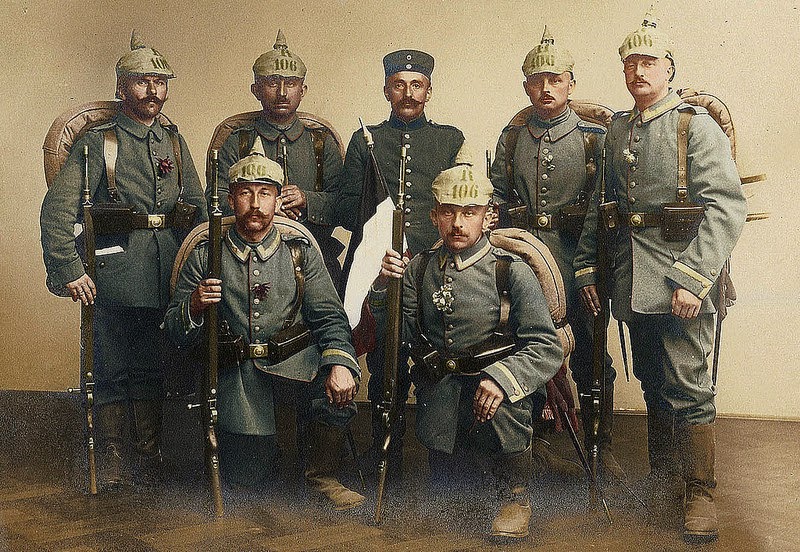
Another beautifully colored picture.
German uniforms 1914.

Here follows a few thoughts on how to play the units in reference to the German Infantry Doctrine used in the great open battles of 1914.

STEP 1: ZUGs advancing.


STEP 2: ZUGs taking light fire, can adopt Skirmish formation,
symbolized by spreading out the bases lightly.


STEP 3: ZUGs advancing under heavy enemy fire, and in need of extra protection can adopt the "Extended Skirmishers" formation, further widening the distance between the bases and breaking up the linear base alignment. This formation will make it harder for enemy automated and artillery fire to target the unit, but also make it increasingly hard for the Company commander to issue effective orders.

I will continue to experiment with rule adaptions, to suit the 1914 tactical situation,
and any suggestions on the matter is much welcome.


Thank you very much for reading!