Sunday, 31 August 2014

Prussian Pincers at the battle of Woerth - 1870

"Vorwärts!!!" 
The Prussian line taking casualties as they charge.

For this year’s summer holiday we decided to travel through some of Europe’s finest wine regions in the search of some good bottles to stash before autumn. Our trip took us from Chianti in Tuscany, north to France and Avignon for some bottles of Rosé at the Tavel district, on through Bourgogne (I’ve read somewhere that the red from Champs Chambertin was Napoleon’s preferred wine) and finally to Alsace for my personal favourite amongst the white wines, the Riesling. 

A quiet corner of Alsace - with a deadly past!

While in beautiful Alsace, I persuaded my fiancée to accompany my on a visit to the historic village of Woerth in the north-eastern corner of the region. Woerth and neighbouring Froeschwiller were the site of a mayor battle 144 years ago, during the initial days of the Franco-Prussian War of 1870-71. Here the 80.000 Germans of the 3rd Army under the Crown Prince surrounded veteran French commander MacMahon and his 35.000 men of the elite 1st Corps in a gigantic Prussian pincer of pikkelhubes and Krupp guns. 

The battle of Woerth - 6th Aug. 1870.
The map also shows the previous border engagement
 at Wissembourg on the 4th.

The outnumbered French fought like lions, some regiments paying with casualty rates nearing 90%, but the German tide supported by their excellent artillery was too great a force, and the defeat of the honourable MacMahon, the hero of Magenta, would send shock waves through the political top in Paris, and cast a serious shadow over French morale. 

The battle rages in front of Froeschwiller.
Total losses on both side exceeded 30.000 men.

Visiting the battlefield today is well worth the journey, and anyone remotely interested in this period, should consider visiting this wonderful region for its history, food and great wines. Woerth has not grown excessively and the characteristic hills to the west of the village, on top of which the French held their defensive position, and up the slopes of which the Germans would keep charging, are still largely intact from any urban expansion.

Excellent flags for the range offered by GMB.

After the Franco-Prussian War ended, Alsace and Lorraine passed to Imperial German possession up to the end of WW1. During this period a series of monuments to the “glorious campaign” were erected on the battlefield. These serve today as waypoints accompanied by signs along the battlefield trail. For those with smart phones with Internet, the battlefield also offers a QR-code access to more info. The code is present on all signs along the trail.

The Bavarians storming the hill.

Roughly in the center is the monumental tower with top floor viewing platform, situated just west of Elsasshausen along the country road. It offers s 360° view of the battlefield, and needles to say, I spend quite a while up there reviewing the grounds, contemplating the desperate fight the French put up.

The view from the monument.
Woerth in the distance, while to the left one sees 
the hill held by the Turcos under Suzzoni.

Naturally I also had to visit the hill held be the legendary Turcos under Colonel Suzzoni.
It was truly a special feeling to stand on the very spot, where this regiment almost got annihilated. To look down the slopes in front of the position, in the direction from which the Bavarians would have made countless charges, and suffered equally horrible losses, in their attempt to take the position.

Froeschwiller today. 
The occasional car and a dog barking in the distance.

Likewise impressive was the number of monuments and memorials sprinkled over the centre of the battlefield. Here I was perhaps most touched by the one dedicated to the French Cuirassiers (Yes, I have a weakness there). Clad in their shiny armours and horsetail helmets, they were a testament to the imperial glory of France, drawing on the heritage from Napoleon I’s days. But now was the era of the breach loading rifles, and their fate at Woerth was grim.

Canister and Chassepot fire thinning the ranks.

I left Woerth and Alsace with loads of inspiration for my 1870 collection, and started putting together a unit of Prussians when I got home. I imagine them struggling forward in a hailstorm of canister and Chassepot fire, charging up the steep slopes towards the French. The figures are from the previous North Star 1866 range, and full of drama and animation, that suited this purpose excellently. 

Thank you very much for reading!

Sunday, 24 August 2014

The 9th French Cuirassiers – 1812

The 9th Cuirassiers.
Figures from Perry - flags GMB.

It is not without a considerable measure of respect that I now humbly touch on what I, and many other period enthusiasts, regard as holy ground - French Cuirassiers.

A wall of metal and a thunder of hooves.

I can still recall the moment and place when I as a 10 year old kid got my first look at these awe inspiring riders. It was in a toyshop with my grandmother, who bought me the 54 mm Airfix plastic French Cuirassiers kit. Now anyone wargaming the Napoleonic period in the late 70ies or 80ies will remember this box. There was something unmistakably majestic about the figure on the box. A feeling that a unit of these riders could invincibly smash through anything the enemy would possibly field. A feeling of adoration that still stays with me today whenever I encounter these gallant riders, with their characteristic horsehair adorned helmets and shiny heavy duty cuirasses. 

The classic Airfix kit that sparked my fascination.

A natural choice for building a collection of Cuirassiers would be the Perry Heavy Cavalry plastic box, and I’ve had a few of these slumbering in a dark corner of my closet since Salute 2012, so it was about time to get on with them.

One of the troopers before basing.
Shows the musket thus dating the unit at 1812 and forward.

I’m aiming at 4 large units, which for my collection means 12 figures per unit. I’ve decided to spiff them up with a few of the metal casualty poses, to generate more animation than the boxes offer. 

In 1812 the 9th Cuirassiers held the following battle honours on their flag: Austerlitz, Jena, Eylau, Friedland, Eckmühl and Wagram. During the Russian campaign the 9th received 2 “Sabre of Honour”, and at Borodino they were part of legendary French cavalry commander Nansouty’s 1st Corp, forming a part of Murat’s Cavalry Reserve. 

Cuirassiers saluting their Emperor before the charge.
The battle of Friedland 1807.

The French Cuirassiers played a key role and formed the brunt of several mounted and very bloody charges on the entrenched Russian artillery and infantry on the Great Redoubt during the afternoon’s fighting at Borodino. Not only at The Moskova but certainly in most of Napoleon’s campaigns, the Cuirassiers were called upon to preform the most difficult and toughest of charges. A role in which they specialized, and often acted as a heavy “snow plough” bearing down on the enemy’s infantry, shaking the very ground with a thunder of hoofs as they charged home. They were formidable in this role, and the heavy elite of their time.

It would take considerable discipline for an 
infantry unit to stand and receive a charge like this. 

As a testament to their ruthless efficiency, a Russian infantry Corps of 30.000 men lost 33% of it’s strength by just one single charge of the French Cuirassiers at the Battle of Montmirail in 1814. 

Regimental colors with battle honors.

In 1804 French cavalry counted 12 of these Cuirassiers regiments, which were lovingly referred to by the rest of the army as “The Big Brothers”. With their heavy double plated cuirass, they were the hammer and the chock troops of the day. Armed of course with their heavy cavalry saber, they also packed two pistols, and from 1812 even a musket with bayonet. 

The Great Redoubt at Borodino 
after the charge of the heavy cavalry.

Under the heavy cuirass the troopers wore a dark blue habite-veste with cuffs and turn backs in regimental colors, as were the tags edging the chabraque made from sheep’s wool. These colors would be red, purplish dark red, yellow and a light rose color. The standard breeches were from light sheep’s skin or on campaign protective riding pants, buttoned in each side.

Cuirassiers charging at Eylau 1807.

The trumpeters would be dressed rather lavishly and with no apparent restrictions up to 1812, when an Imperial decree ordered them into habite-vestes of complimentary colors (the Funcken plates show green yellow and rose), no cuirass and white horses hair in their helmet.

Awe inspiring film clip showing 
the true punch of a Cuirassiers charge.

I will leave you with this short clip from the 1994 movie Colonel Chabert. It shows the “Eagles of Eylau” –the French Cuirassiers as they charged into the Russian line. The mere sound of a distant thunder of hooves building up can give me goose bumps – imagine being an enemy infantryman on the receiving end of such a charge!

Thank you very much for reading!


Sunday, 17 August 2014

French Voltigeurs – 1812

 French Voltigeurs based on 40x40 bases. 
Only two figures per bases to signify skirmishers.
Figures are all Victrix.

Yet again I return to the baneful field of the Moskova to add to my Borodino collection, this time to start work on the French infantry. 

At Borodino no less than 120.000 men of La Grande Armée were present under Le Tricolore, and I decided that the first units to cross the painting table would be the ones initially committed in the attack on the fleeches. So accordingly I’ve acquired the GMB flags for the 57th and 25th infantry regiments, part of Davout’s 1st Army Corps, as both units were at the very front of this first push at Bagration’s defences.

Before painting the line infantry figures, I wanted to do up a few units of French Voltigeurs. These skirmish specialists would be applied en masse as a swarm in front of the charging infantry columns, a tactic somewhat perfected by the French, and thus a natural addition to my collection.

A Funcken plate showing French fusiliers, grenadiers and 
voltigeurs in the period 1806-1810.

The Voltiguers were men chosen for the small physical size, their agility and their expert marksmanship. Their main tactical function on the battlefield would be to spread out thin and screen the enemy forces with a constant and harassing fire, enough to keep an annoying level of stress in the ranks of whomever the French were fighting.

The main armament was the 1777 musket, weighing in at 4,65 kg and measuring 1,53 metres in length and using a 17,5 mm calibre ball. This weapon was only reliable up to 110 metres, and thus inferior to many of the weapons of the other European armies at the time. Despite some attempts and modifications, the French infantrymen often threw away their issued musket when they had gotten their hands on a foreign weapon after a battle.

The voltigeur units had no tambours, only cornets.
The hunting horn on pouch a clear reference to role of the light infantry.

In terms of uniforms, the light infantry wore the standard habite-veste but with small modifications to the colors of for instance the epaulettes. Also the Light infantry was first to adopt the Hungarian Chakot.

Deployed for battle, a French battalion would field its fusiliers in the centre while grenadiers would be to the right and the voltigeurs to the left. Two or three regiments would form a standard brigade, while two such brigades would form a division.

Close up of one of the bases.

In the initial charges on the fleeches at Borodino, the French divisional commander Compans, choose to attack the Russians using a small wood as cover for his advance. This skilful move was however repulsed and the brave Compans himself wounded in this opening move.

The Russians, who understood that the attack was no feint, started to pour in reinforcements. At the same time Davout, a legendary Marshall of France who was no stranger to peril, rode forward personally leading the 57th in the subsequent charge. He succeeded in pushing back the Russians and capturing the outpost. 

A unit of French voltigeurs inch forward 
while skrimishing with the enemy.

Bagration would have none of it, and immediately committed both a regiment of hussars and the heavier cuirassiers in and effort to push back the determined French infantry. This called for yet a French counterattack, which was ordered without delay, and the 1st Cavalry Corps made a crushing charge, repelling the Russian horse. This jabbing back and forth at the fleeches later spiralled out of control, and the centre of the Borodino battlefield would eventually suck in both Ney’s and Davout’s complete forces and reserves. 

Voltigeurs on a river recon - Wagram campaign.

But the French Army had finally got the long waited chance to fight the Russians, and Napoleon, in my opinion not showing too much of his characteristic tactical genius, was determined to grind it out with a simple frontal charge on a defensive position. Something the Russians were all too happy to accommodate.

Next up the classic charge of the French Cuirassiers and the push on the big redoubt.

Thank you very much for reading!

Saturday, 9 August 2014

Picking up the brushes again - French Elite Dragoons 1812

The elite company of the 7th charging forward

Dear readers trust this update finds you all well. The Black Powder Games Blog have for some weeks now been resting quietly in the cool shade, while yours truly have been out and around getting either scorched or drenched by the rather extreme summer weather we’ve experienced in Europe. 

French Dragoons - Funcken plate.
The elite trooper is seen forward left.

This year’s summer holiday took us through some of France’s finest wine regions. Most notably we visited Alsace to get our hands on some good Riesling. While in the region I managed to persuade my fiancée to spend a day with me walking the historic grounds around Woerth, the site of a mayor Franco-Prussian battle in 1870. As it turns out, the Alsacians have not forgotten this part of their turbulent history – but more about that in a later post.

"Russia against Napoleon" by Dominic Lieven.
In my opinion the best book, not only on Borodino, but on the complete 1812-1814 
joust of giants between the two "eagles" the Tzar and the Emperor.

One of the books I enjoyed reading, as I was sweating it out in the poolside umbrella shade, was the excellent “Russia against Napoleon” by Dominic Lieven. 

Recently published (2009) I found it a very refreshing and detailed source, taking Russia’s perspective on the 1812 campaign, and subsequent defeat of Napoleon in 1814. The book covers the total spectre of this timeline, and I’d highly recommend it to anyone interested in this part of the Napoleonic Wars and the spectacular Russian army of 1812-1814.

The bugler - characterized by the different colors worn on 
Colback, Habite-veste and Chabraque.

But now it’s time to get back to the painting table and to the blog.
Freshly inspired by the Lieven book I threw myself at some Elite Dragoons constructed from the Perry French Dragoon box. 

Borodino or as the French call it "The Moskova"

As my collection is aimed mainly at Borodino and 1812, this unit is fielding the flag of the 7th Dragoons, which would put them in Thiry’s brigade, part of Grouchy’s 3rd Cavalry Corps. A veteran unit of Austerlitz, where their Colonel was awarded the Legion d'honneur for capturing the Austrian General de Wimpfen, the 7th was again in the thick of it at The Moskova. Grouchy’s Corps was one of many sucked into the fray at the Great Redoubt, where he made several charges at the Russian infantry squares formed behind it.

The regimental standard - the 7th made several charges at Borodino,
so I spiced up the ranks with a wounded hero.

The Elite Dragoons were men of certain merit, drawn from the ranks to form a crack elite company within the regiment. They were distinguished by the bearskin “Colback” and the red epaulettes, similar to those of the sapeurs. 

"The capturer of de Wimpfen"
The Colonel of the 7th was awarded the Legion d'Honneur 
for capturing the Austrian General at Austerlitz.

Their uniform had been almost unchanged since 1791, but in 1812 they were issued the new habite-veste, which was close to that of the infantry in cut and design. Weapons-wise they carried a sabre, a pistol and the model 1777 musket (1,41 m) to which they were able to attach a bayonet. This mix of cavalry and infantry weaponry was a testament to the tactical DNA of the Dragoons, meant to fight one moment as mobile light infantry and another as formed cavalry.

Another shot of the bugler. 
The Perrys know how to make them, a pleasure to paint these.

Their chabraque was made from sheepskin lined with tags carrying the regimental colour (Key colours were yellow, orange, red and purple). In order to have the bugler stand out, he would be saddled on a black sheepskin while wearing habite-veste and Colback in complementart colors to the rest of the unit.

Shot from above to reveal the Colback top detail of the white cross on red.

With 30 regiments raised in total, the French Dragoon force proved a vital component in Napoleon’s Spanish campaign, and would later win further glory at Nangis and Provins during the desperate fighting in France in 1814. 

Thank you very much for reading!

Friday, 18 July 2014

Goliath ships, witch burnings and naval catastrophes – The Scanian War

The AD16 from Langton Miniatures Anglo Dutch range 
here painted as Kronan.

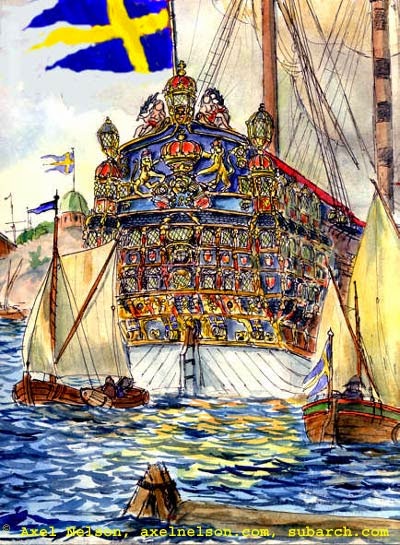
The flagship Kronan (ENG: The Crown) was as its name implies the crown jewel of the Swedish navy during the late 17th century. Build at the Skeppsholmen Royal Wharf in Stockholm, and launched in 1668 weighing some 2.300 tons with its 105 guns and 800-man crew, this was one of the Worlds largest ships of its time.

The beautifully decorated stern of Kronan.

Kronan showed ambition, and was intended as a true testament to the military might of the Swedish Empire, which was at its pinnacle during these years. What tied together the Empire with its possessions in northern Germany, Finland and the Baltic states was the Baltic Sea. However Denmark, with it’s superior navy and naval tradition, had historically ruled the Nordic waves. But Sweden intended to change all that, as Kronan would outmatch anything that could be mustered by the Danes.

Kronan; 105 guns and 800-man crew.

With the outbreak of the Scanian War in 1675, it was time to finally teach the Danes a lesson in naval might. 

Sweden’s expansion into Empire was fueled by a deep-rooted military tradition, and left it with a highly capable and innovative army staff, with commanders and tactical doctrines superior to their adversaries. At the same time, the expansion into Empire had also spawned a new race of government administrators with inspirational figures as Axel Oxenstierna (The Richelieu of the North) as their role model. One of these upcoming administrative career sharks was Lorentz Creutz.

Lorentz Creutz, 1615-1676.
Witch hunter and Admiral on Kronan.

Coming from noble decent, Creutz had made a career as regional administrator, at first in some of the Finnish territories but later, and more famously in some of the native Swedish areas.

In 1669 the witch hysteria broke out in the Swedish region of Dalecarlia. Around 90 people were pointed out as being in league with the Black Lord himself, and some of having abducted a score of children to Blåkulla (ENG: Blue Mountain). A few women were even pointed out and accused by their own daughters; others had their name added to the list by use of torture. A trial was arranged to test the dubious innocence of these foul Satanists, and the honorable Lorentz Creutz was appointed to lead it. He hastily left Stockholm to attend the proceedings.

The flames of a hot stake - sure to cleanse the body of any evil.

Out of this colorful bunch of peasantry amounting to 90 people on trial (many elderly women), some were completely freed, as they were children, while others simply had their execution delayed due to pregnancy. However the court managed to convict some 30 people, who were put to the stake – enough to give a good show. 

30 people, mostly elderly women, 
were put to the stake as a result of the witch trials executed by Lorentz Creutz.

 The children who had so willingly acted as witnesses were all thoroughly whipped, in order to cleanse them of any “evil”. A black and ominous atmosphere hung over Dalecarlia in these days, and it is said that the women of the Mora Shire came together to cast a curse on the man leading these horrible proceedings, Lorentz Creutz.

An attempt to recreate the colorful stern in 1:1200 scale.

The King, so overly pleased with Creutz’s handling of the situation, promoted him to a seat in the Royal Council in 1673. Creutz was the man of the hour, and in the King’s eye a natural choice when looking for a capable man to lead the Swedish Navy in it’s coming test of strength with the Danes, with the main tactical objective of opening the seaway to Sweden’s German possession, badly in need of reinforcements. 

Creutz proudly boarded his beautiful flagship Kronan in Stockholm mid-May 1676, and the impressive navy set sails out of the archipelago and on to a southwards and what would prove to be fateful course.

Claas Uggla 1614-1676.
Arguably one of Sweden's best admirals ever.

A Danish naval force of some 42 ships lead by the talented Dutch Admiral Tromp and assisted by Danish naval legend Niels Juel, awaited the Swedes at Öland in the Baltic Sea. Creutz directed a fleet of 57 vessels, and was assisted by perhaps one of Sweden’s most able naval commanders, Claas Uggla. The scene was set for an epic struggle.

The Battle of Öland 1st June 1676.

The Danes, upon seeing the huge silhouette of Kronan in the horizon, were naturally cautious, and left the initiative to the Swedes. Creutz, perhaps feeling extra empowered as he stood on the bridge of the massive Kronan, starting making a series of very complex manoeuvres. One such order was to turn up against the wind, and thus attain a better line at the awaiting enemy.

Kronan approaching the Danes at full sails.

The Danes watched in amazement as the giant ship started this alluring dance, and was subsequently tossed around in the waves. In all the excitement of finally getting to deal out doom to the Danes, Creutz and his second in command had forgotten to give the order to close the gunports, and Kronan started to take in a lot of water as the wind pushed it down on its side. This upset the balance of the giant ship, and it quickly capsized. This embarrassment would however turn into a catastrophe for Creutz.

Kronan's apocalyptical end.

With the Danish navy as a stunned audience, this now capsized goliath of the waves and pride of the Swedish navy suddenly exploded into a huge fireball, throwing burning bodies and wooden debris high up into the air. 

All eyes, Swedish as well as Danish, turned in amazement towards the apocalyptic spectacle. The unthinkable had just happened.

The Swedish navy was all but decimated at Öland.

The ensuing naval combat was by all means lost by the now morally zapped Swedes, although testament must be given to the bravery of Claas Uggla, who fought to the bitter end on his surrounded and burning ship, Svärdet (ENG: The Sword), and duly went down with it.

1:1200 - bring out the thin brushes!

After the battle the completely scorched body of Admiral Lorentz Creutz was found floating amongst the debris, only identifiable by his nobility signet ring. I imagine one or two of the women in Mora Shire were not too surprised by his grim fate, and by the cast curse now manifest. 

The Kronan wreck has been a rich source 
for artifacts, uniforms and weaponry.

Kronan went down with only 40 survivors of its 800-man crew. Today the wreck is well preserved and many dives have been made, with finds of artifacts, uniforms, coins and weaponry constituting the core of the Kronan Exhibition at museum in Kalmar next to Öland. 

Thank you very much for reading!

Thursday, 10 July 2014

French Skirmish Line – 1870

Lignards, officers and chasseurs clinging on the their position.

This unit is in a way an ode to my friend Barry Hilton of Warfare Miniatures, and his “I wanna tell you a story” approach to basing his figures. The idea to create a playable unit, but basing it with all the drama and animation of a vignette caught my imagination, and I decided to give it a go.
After flicking through my jpg collection of Franco-Prussian paintings, I settled on the classic image of a French Franco-Prussian skirmish line, holding on heroically while suffering murderous losses. 

"The Line of Fire" Painting by Pierre-George Jeanniot 1886.
Museum of 1870 - Gravelotte.

For those of you familiar with the work of Édouard Detaille, Alphonse de Neuville and Pierre-George Jeanniot, you will recognise this national romantic melancholy sting, which were present in many of the Post War French paintings, as France digested the result of the war and mourned the loss of Alsace-Lorraine.

Detail: a wounded soldier rests his back 
against the wrecked wheel of a canon.

My storytelling unit would take inspiration from Pierre-George Jeanniot’s “The Line of Fire” from 1886. The painting is enormous and extremely impressive. Today it can be seen as part of the permanent exhibition of the 1870 Museum in Gravelotte, so in a way it came home.

Detail: a dead chasseur offering cover to his comrades.

When it became time for basing, I used my standard Victrix 40x40mm bases, a set of three constituting a standard size unit. Now, I wanted to also be able to play this as a skirmish unit, so each base should be able to work on it’s own. It was a welcome challenge, and the result left me with an appetite for further experiments.

Base 1/3

Base 2/3

Base 3/3

As part of my study on the French army of the Franco-Prussian War, I’ve recently acquired the French Military Drill School manual for officers in the infantry. Published 1870 and containing the updated regulations of a decree from 16. March 1869, it’s the most recent version before the outbreak of the Franco-Prussian War, and the version that would have been carried by the French officers to the battlefields in Eastern France.

"Manæuvres de l'infanterie"
1870 edition published by Ministére de la Guerre 
in collaboration with Librairie Militaire de J. Dumaine.
Paris 1870.

Offering quick reference tables of fire distance to kill on approaching infantry and cavalry along with a multitude of manoeuvres and rules of deployment in the field, this manual gives one an interesting view into the tactical development within the French army of 1870.

An interesting insight to French infantry tactics anno 1870.

So, why did the French apply such defensive strategy during the Imperial campaign of the Franco-Prussian War? One reason is the overcautious almost passive French high command, but interestingly another was the French infantry’s awareness of their superior Chassepot Bolt Action rifle. Beside offering the opportunity for infantry to fire and reload while kneeling or lying down, the Chassepot would out-reach the German Dreyse Needle Guns by more than the double distance (1.200 meters vs 590 meter). This compelled the French, who by no means were strangers to gallant but often fruitless counter attacks, to take up defensive positions and await the approach of the German infantry.

Bird's eye view on the unit.

The Germans in their turn, would rely on a smooth and effective high command using the synergies of having the initiative, the dash and grit of their infantry tactics but most of all, they would enjoy a decisive superiority in artillery, bashing any and all French defensive position with their state-of-the-art Krupp artillery. This is perhaps best illustrated in the losses suffered by each side. Statistically a German soldier would die from a Chassepot bullet, while a French lignard would become a casualty to a Krupp shell.

Thank you very much for reading!