Friday, 18 July 2014

Goliath ships, witch burnings and naval catastrophes – The Scanian War

The AD16 from Langton Miniatures Anglo Dutch range 
here painted as Kronan.

The flagship Kronan (ENG: The Crown) was as its name implies the crown jewel of the Swedish navy during the late 17th century. Build at the Skeppsholmen Royal Wharf in Stockholm, and launched in 1668 weighing some 2.300 tons with its 105 guns and 800-man crew, this was one of the Worlds largest ships of its time.
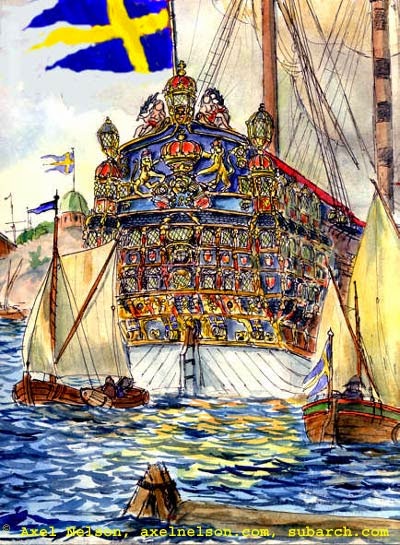
The beautifully decorated stern of Kronan.

Kronan showed ambition, and was intended as a true testament to the military might of the Swedish Empire, which was at its pinnacle during these years. What tied together the Empire with its possessions in northern Germany, Finland and the Baltic states was the Baltic Sea. However Denmark, with it’s superior navy and naval tradition, had historically ruled the Nordic waves. But Sweden intended to change all that, as Kronan would outmatch anything that could be mustered by the Danes.

Kronan; 105 guns and 800-man crew.

With the outbreak of the Scanian War in 1675, it was time to finally teach the Danes a lesson in naval might. 

Sweden’s expansion into Empire was fueled by a deep-rooted military tradition, and left it with a highly capable and innovative army staff, with commanders and tactical doctrines superior to their adversaries. At the same time, the expansion into Empire had also spawned a new race of government administrators with inspirational figures as Axel Oxenstierna (The Richelieu of the North) as their role model. One of these upcoming administrative career sharks was Lorentz Creutz.

Lorentz Creutz, 1615-1676.
Witch hunter and Admiral on Kronan.

Coming from noble decent, Creutz had made a career as regional administrator, at first in some of the Finnish territories but later, and more famously in some of the native Swedish areas.

In 1669 the witch hysteria broke out in the Swedish region of Dalecarlia. Around 90 people were pointed out as being in league with the Black Lord himself, and some of having abducted a score of children to Blåkulla (ENG: Blue Mountain). A few women were even pointed out and accused by their own daughters; others had their name added to the list by use of torture. A trial was arranged to test the dubious innocence of these foul Satanists, and the honorable Lorentz Creutz was appointed to lead it. He hastily left Stockholm to attend the proceedings.

The flames of a hot stake - sure to cleanse the body of any evil.

Out of this colorful bunch of peasantry amounting to 90 people on trial (many elderly women), some were completely freed, as they were children, while others simply had their execution delayed due to pregnancy. However the court managed to convict some 30 people, who were put to the stake – enough to give a good show. 

30 people, mostly elderly women, 
were put to the stake as a result of the witch trials executed by Lorentz Creutz.

 The children who had so willingly acted as witnesses were all thoroughly whipped, in order to cleanse them of any “evil”. A black and ominous atmosphere hung over Dalecarlia in these days, and it is said that the women of the Mora Shire came together to cast a curse on the man leading these horrible proceedings, Lorentz Creutz.

An attempt to recreate the colorful stern in 1:1200 scale.

The King, so overly pleased with Creutz’s handling of the situation, promoted him to a seat in the Royal Council in 1673. Creutz was the man of the hour, and in the King’s eye a natural choice when looking for a capable man to lead the Swedish Navy in it’s coming test of strength with the Danes, with the main tactical objective of opening the seaway to Sweden’s German possession, badly in need of reinforcements. 

Creutz proudly boarded his beautiful flagship Kronan in Stockholm mid-May 1676, and the impressive navy set sails out of the archipelago and on to a southwards and what would prove to be fateful course.

Claas Uggla 1614-1676.
Arguably one of Sweden's best admirals ever.

A Danish naval force of some 42 ships lead by the talented Dutch Admiral Tromp and assisted by Danish naval legend Niels Juel, awaited the Swedes at Öland in the Baltic Sea. Creutz directed a fleet of 57 vessels, and was assisted by perhaps one of Sweden’s most able naval commanders, Claas Uggla. The scene was set for an epic struggle.

The Battle of Öland 1st June 1676.

The Danes, upon seeing the huge silhouette of Kronan in the horizon, were naturally cautious, and left the initiative to the Swedes. Creutz, perhaps feeling extra empowered as he stood on the bridge of the massive Kronan, starting making a series of very complex manoeuvres. One such order was to turn up against the wind, and thus attain a better line at the awaiting enemy.

Kronan approaching the Danes at full sails.

The Danes watched in amazement as the giant ship started this alluring dance, and was subsequently tossed around in the waves. In all the excitement of finally getting to deal out doom to the Danes, Creutz and his second in command had forgotten to give the order to close the gunports, and Kronan started to take in a lot of water as the wind pushed it down on its side. This upset the balance of the giant ship, and it quickly capsized. This embarrassment would however turn into a catastrophe for Creutz.

Kronan's apocalyptical end.

With the Danish navy as a stunned audience, this now capsized goliath of the waves and pride of the Swedish navy suddenly exploded into a huge fireball, throwing burning bodies and wooden debris high up into the air. 

All eyes, Swedish as well as Danish, turned in amazement towards the apocalyptic spectacle. The unthinkable had just happened.

The Swedish navy was all but decimated at Öland.

The ensuing naval combat was by all means lost by the now morally zapped Swedes, although testament must be given to the bravery of Claas Uggla, who fought to the bitter end on his surrounded and burning ship, Svärdet (ENG: The Sword), and duly went down with it.

1:1200 - bring out the thin brushes!

After the battle the completely scorched body of Admiral Lorentz Creutz was found floating amongst the debris, only identifiable by his nobility signet ring. I imagine one or two of the women in Mora Shire were not too surprised by his grim fate, and by the cast curse now manifest. 

The Kronan wreck has been a rich source 
for artifacts, uniforms and weaponry.

Kronan went down with only 40 survivors of its 800-man crew. Today the wreck is well preserved and many dives have been made, with finds of artifacts, uniforms, coins and weaponry constituting the core of the Kronan Exhibition at museum in Kalmar next to Öland. 

Thank you very much for reading!

Thursday, 10 July 2014

French Skirmish Line – 1870

Lignards, officers and chasseurs clinging on the their position.

This unit is in a way an ode to my friend Barry Hilton of Warfare Miniatures, and his “I wanna tell you a story” approach to basing his figures. The idea to create a playable unit, but basing it with all the drama and animation of a vignette caught my imagination, and I decided to give it a go.
After flicking through my jpg collection of Franco-Prussian paintings, I settled on the classic image of a French Franco-Prussian skirmish line, holding on heroically while suffering murderous losses. 

"The Line of Fire" Painting by Pierre-George Jeanniot 1886.
Museum of 1870 - Gravelotte.

For those of you familiar with the work of Édouard Detaille, Alphonse de Neuville and Pierre-George Jeanniot, you will recognise this national romantic melancholy sting, which were present in many of the Post War French paintings, as France digested the result of the war and mourned the loss of Alsace-Lorraine.

Detail: a wounded soldier rests his back 
against the wrecked wheel of a canon.

My storytelling unit would take inspiration from Pierre-George Jeanniot’s “The Line of Fire” from 1886. The painting is enormous and extremely impressive. Today it can be seen as part of the permanent exhibition of the 1870 Museum in Gravelotte, so in a way it came home.

Detail: a dead chasseur offering cover to his comrades.

When it became time for basing, I used my standard Victrix 40x40mm bases, a set of three constituting a standard size unit. Now, I wanted to also be able to play this as a skirmish unit, so each base should be able to work on it’s own. It was a welcome challenge, and the result left me with an appetite for further experiments.

Base 1/3

Base 2/3

Base 3/3

As part of my study on the French army of the Franco-Prussian War, I’ve recently acquired the French Military Drill School manual for officers in the infantry. Published 1870 and containing the updated regulations of a decree from 16. March 1869, it’s the most recent version before the outbreak of the Franco-Prussian War, and the version that would have been carried by the French officers to the battlefields in Eastern France.

"Manæuvres de l'infanterie"
1870 edition published by Ministére de la Guerre 
in collaboration with Librairie Militaire de J. Dumaine.
Paris 1870.

Offering quick reference tables of fire distance to kill on approaching infantry and cavalry along with a multitude of manoeuvres and rules of deployment in the field, this manual gives one an interesting view into the tactical development within the French army of 1870.

An interesting insight to French infantry tactics anno 1870.

So, why did the French apply such defensive strategy during the Imperial campaign of the Franco-Prussian War? One reason is the overcautious almost passive French high command, but interestingly another was the French infantry’s awareness of their superior Chassepot Bolt Action rifle. Beside offering the opportunity for infantry to fire and reload while kneeling or lying down, the Chassepot would out-reach the German Dreyse Needle Guns by more than the double distance (1.200 meters vs 590 meter). This compelled the French, who by no means were strangers to gallant but often fruitless counter attacks, to take up defensive positions and await the approach of the German infantry.

Bird's eye view on the unit.

The Germans in their turn, would rely on a smooth and effective high command using the synergies of having the initiative, the dash and grit of their infantry tactics but most of all, they would enjoy a decisive superiority in artillery, bashing any and all French defensive position with their state-of-the-art Krupp artillery. This is perhaps best illustrated in the losses suffered by each side. Statistically a German soldier would die from a Chassepot bullet, while a French lignard would become a casualty to a Krupp shell.

Thank you very much for reading!


Saturday, 5 July 2014

Thirty Years War figures from Horcata Miniatures - A Review

Horcata Miniatures Light Cavalryman.
(The Horse is Front Rank)

When visiting SALUTE this year I had arranged to meet up with Czech miniature producer Emil Horky, the owner of Horcata Miniatures. Emil was there for the second time, and was accompagnied by his son who is also interested in the hobby.
It was a real pleasure meeting the Horkys, and their miniatures deserve some attention here on the blog. Something for all you interested in the Thirty Years War or ECW.

Same miniature seen from the other side.
Lovely clean sculpting with clear details = easy to paint!

I first found Horcata Miniatures when searching the internet for really good Thirty Year War miniatures in 28 mm. For me this means modern sculpting, naturally proportioned miniatures and reasonable prices.

Their website give away Horcata Miniatures as a very personal project run by a period enthusiast, and my God the miniatures were fantastic. Sculpted by Paul Hicks, and with both cavalry and infantry in abundance, I couldn’t keep away.

Bugler

Packaging:
The figures are delivered carefully wrapped and packaged.
There is no branded packaging or extras, just high quality miniatures.

Cuirassier discharging pistol.
Perfect for your caracole formation.

Sculpting:
The range is sculpted by Paul Hicks, and in all the positive ways imaginable this shows.
It’s very clean and crisp sculpting, with well-proportioned miniature looking incredibly inviting to paint. Also there doesn’t seem to be a lot of recycled figures/poses. They all look very individually made, and this will of course add character to the finished units.

Size Comparison:
Left to right: Foundry, Horcata and Warlord.

Size:
The horsemen are about 30 mm from heel to tip of the head.
This is about the same size as for instance Warlords plastic ECW cavalry.
Comparing them with Foundry and Warlord, I find Horcata mixes very well with both,
and should anyone have a collection in the mentioned makes, I wouldn’t think twice about mixing in some of the Horcata minis, even in the same units to spice them up.

Cornet

Price: 
Each figure is GBP 1.40 - cavalry and infantry alike.
However, the horses will add an extra GBP 1.90 (see Range),
so each cavalry figure is really GBP 3.30 per figure & horse.
Foundry is about GBP 4.00 per figure & horse
Warlord metal blisters are about GBP 2.33 per figure & horse.
Warlord plastic cavalry about GBP 1.66 per figure & horse.

Light cavalryman skirmishing

Range:
At the moment Horcata offers 17 different cavalry figures and 33 different infantry figures. That is actually really good, when considering in a normal plastic kit you’ll get 2-4 dollies with a few arms/heads options. So there is real potential to add some character to your ranks with Horcata.
A note about the cavalry; Horcata offers only the riders. Each miniature is sculpted with saddle to fit the horses from Front Rank Miniatures, which is OK, as long as you’re aware of this. 

The infantry range is full of character!

Fluff: 
The website contains both historical info on the Thirty Years War, a blog with regular updates on the range and a webshop which helpfully have imagery showing the miniatures washed in black for better view of the sculpting. 

Lovely animation in the sculpting.

Rating: 8/10. 
Horcata Miniatures would get a clear 10 points for the quality of their miniatures, but with a deduction for not having their own horses and the lack of branded packaging (which could really push this amazing product) I’m at 8 points in total. 

So, dear Wargamers - if you don’t have these minis in your TYW or ECW collection, you’re missing out on some real characters for your ranks.

Thank you very much for reading!


Sunday, 29 June 2014

The Battle of Rezonville and Von Bredow's Death-Ride - 1870

Von Bredow's Death-Ride - arguably the last successful
 cavalry charge in European history.

Dear reader, here follows my third and last account from the visit made to the battlefields around Metz - this time looking at the Battle of Rezonville (a.k.a Mars-La-Tour or Vionville, depending on taste and allegiance). I do find it somewhat hard to constrain myself when writing about this my favorite period of political/military history, so please forgive the rather long post. I've spiced it up with pictures from my visit to the actual battlefield and of my Franco-Prussian miniatures collection. Hope you will enjoy.

- * -

On the morning of 16th August 1870, the bulk of the French Army of the Rhine would fight an engagement initiated by the advance-guard of the German Second Army. Greatly outnumbered, the German Corps commander would find his defensive enemy unwilling to use the advantage of numbers, and the battle would be a close fought action most notably remembered for the self-sacrificial but skilfully preformed attack of Von Bredow’s cavalry on the artillery enforced French line, an attack known as Von Bredow’s Death-ride.

The battle have had many names, English sources often call it Mars-la-Tour, French refer to it as Rezonville, while I've seen German texts using Vionville. I'm not going to attempt a conclusion as to which is more correct.

The background: After the initial French defeats of Spichern and Woerth at the border, both Bazaine (Army of the Rhine) and MacMahon (1st & 5th Corps) withdrew their armies. MacMahon marched all the way to Châlons (300 km from the front), in order to reform and rebuild his shattered troops.

The battlefield as it look around noon on the 16th Aug.
Source: French magazine "Champs de Bataille" 

As German superiority of numbers was becoming all to clear to the French, Bazaine – who had anchored his army at Metz, further north-east - wanted to link up with MacMahon, and hopefully by combining their strength be able to push back the now rolling German advance into France.

Battlefield photo: Looking north from a position outside Vionville.
The French would be formed at the edge of the woods.

German tactical overlord, Moltke, however anticipated this move, and while the Prussian First Army would press forward on the French from a direction due east of Metz, he requested the Second Army under Prince Frederick Charles, to stop it’s advance across the Moselle River and swing north thus encircling Bazaine, and cutting off any attempt to link up by the French commanders.

The French line at the edge of the wood.
Figures a mix of Foundry and Perry miniatures.

On the 16th august, Bazaine had just begun his depart from Metz marching towards Châlons, and the main part of his army was concentrated around the villages of Gravelotte, Rezonville and Vionville on the country road leading westward out of Metz.

As the advance guard of the German Second Army approached the resting French, and the German Corps Commander Alvensleben only thought he was facing a minor French force from Bazaine’s rear-guard, the scene was set for one of the most notable engagements of the Franco-Prussian War.

Battlefield photo: The woods egde.
Here the forward French line would be deployed.

At 09.00 the first German artillery deployed and started pounding away on the coffee-sipping French encamped in Vionville. The fight was on, and the French battle line would be stretched out from a position north of Mars-la-Tour and across the gentle rolling fields to the village of Gravelotte ca. 6 kilometres further east. 

Initial German advance pushed the French out of Vionville and back to a position at Rezonville, where the Imperial Guard now formed the anchor on the French left flank, protecting the vital communications back to Metz.

The 7th Magdeburg Cuirassiers.
Figures all Foundry.

The Germans now realized the true size of the French force across the field. One German Corps was facing a complete French army. But the German commander Alvensleben did not deter, and skilfully arranged his limited troops making excellent use of the superior German artillery by deploying it in a masses battery amounting to 200+ guns between the Bois de St Arnould and Flavigny to the southeast of Vionville. In fact, this effective concentration of German firepower would successfully convince the French command that they were facing a large German force.

Battlefield photo: Map found next to memorial at the battlefield.
It shows the site of Von Bredow's charge (seen in a North to South angle)

In an attempt to counter the German advance, French Corps commander Frossard got permission to launch an attack comprising the Cuirassiers and Lancers of the Guard. The cavalry colonel charged with this unenviable task openly complained at the limited prospects of success, but was overruled, and thus formed his costly elite troops and dashed away in the direction of the German lines.

Battlefield photo: Looking down towards Bois de Tronville from the middle 
of the battlefield. It is from this direction Von Bredow would come sneaking up.

The effective rifle fire of the formed German infantry reduced the crème of the French Imperial cavalry to shambles in just a few moments. The fleeing remnants were pursued by German cavalry all the way back to the French line, where Bazaine and his entourage briefly got involved in the melee, before the Germans finally turned back. 

Von Bredow's Charge. Map drawn up by Austrian officer, and published in the manuals of the Austrian "Kriegsshule" (Militaryacademy).
The map is kindly supplied by fellow Contiental Wars Society member, Andrew Brentnall.

Just before noon Alvensleben had scouted the French position swelling and strengthening to his front. Especially the forming of a French artillery battery on the field northwest of Rezonville was menacing to any German hopes to press an attack. 
Orders thus passed to General Von Bredow asking him to take this position, using the fresh reserves of the 5th Cavalry Division.

The "zug" of cuirassiers dashing for the French canons.

Von Bredow took one glance at the French position to his front, and after airing initial protests and receiving the confirmation to go ahead, he stoically remarked: “Koste es, was es wolle” - “It will cost what it will”. He formed up the 7th “Magdeburg” Cuirassiers and the lance-armed 16th Uhlans, and swung out from behind the safety of Vionville.

Battlefield photo: This is the ground Von Bredow would see as he came up from the depression in the ground nearing the French line at the wood's edge.

Von Bredow advanced towards the French line, making careful use of the rolling landscape. He would lead his men through a little depression in the fields before the targeted gun position, and thus enabling his troops to get within 100-200 meters before the charge was sounded and his men exposed. 

Capt. H.M. Hozier describes two consecutive charges into infantry columns. 

Here is the charge as described by Captain H. M. Hozier, whom took part in this fearful ride:

“Our brave general, with his staff of four officers, three of which he lost, was nearly on a line with the cuirassiers. Before the French battery had discharged it’s third gun, we were masters of it. The honour of challenging the French commander I could not leave to another, and I rather think I found him. It was clear to me that in this death-ride the objective was not to bring home trophies, but to strike down everything between the wood and the road. At the battery all were put to the sword, and then we went in tearing course at an infantry column, which was ridden over and cut down. Its remnants, however, sent a good many shots after us. At this moment the dragoons were close on our heels. A second battery was attacked, and all who did not run were put to the sword. Then, as many as were left of us made for a second infantry column. Just before reaching it two squadrons of French cuirassiers wheeled from a woody hollow into the gaps of our little handful, and after the last infantry column had been ridden down we wheeled to the right and rushed back. 

The French gunners "put to the sword".

By this time we were pell-mell with the French horse. Before the battery I received two shots, which went through my helmet, without, however, touching me. The adjutant, hit by two bullets, fell from his horse; one trumpeter was shot down, the horse of the other wounded. I was just speaking with Captain Heister when he also fell. Lieutenant Campbell was for a while by my side until, in the attempt to tear away from the French cuirassiers the standard he had seizes with his left hand, he was fearfully maltreated. Someone helped him to cut his way out. I shall never forget my ordering the first trumpeter I found, nearly on the same spot where we set out on our ride of nearly a quarter of a German mile, to blow the regimental signal. The trumpet had been bored through by shots, and a sound came that pierced me to the quick. At my call three sections out of the eleven assembled. A gloomy bivouac followed, as little more than a fourth of the regiment had responded to the call!”
(Source: The Franco-Prussian War by Capt. H. M. Hozier, published 1875)

The units participating in Von Bredow's Death-ride
suffered around 70% losses.

Von Bredow’s Death Ride and the ensuing cavalry melee, fought while detaching from the French line, left no more than 25-30% survivors. However the military objective of the charge had been met with great success. With the French gun position reduced and Canrobert’s line left in disorder, the Germans had bought them selves precious time to regroup and bring up more reinforcements. 

Battlefield photo: Memorial situated at the position of the second French line.
Roughly from were the French cavalry would have counter-charged.
The position of the French guns marked in the background by the row of trees. 

The success of Von Bredow is not little matter. It can even be put in comparison to the parallel action of his French counterpart of the Imperial Guard cavalry whom tried but failed so miserably. The time for massed cavalry assault was definitely over, but Von Bredow’s clever use of the ground would leave this last testament to the gallant charge of horses.

Thank you very much for reading!

Friday, 20 June 2014

Landsknecht Pike Block – Italian Wars


A forest of pikes and a sea of lace.

Following the lead of last weeks post, I return yet again to the time of lace-clad Renaissance warriors with a second row of landsknechts, completing my first pike block. Each Landsknecht pike block for my Italian Wars collection will be winged with a set of 3-base arquebus units, building on the Spanish firepower heritage of the imperial army at the time of Charles V. 

The second row.
Any willing Doppelsoldners? Come on now...

In order to familiarize with the subject standing on my painting table, I set out to investigate the origins of the Landsknechts. The word Landsknecht perhaps unsurprisingly originates from German, and can be translated roughly into knight or servant of the land. The term landsknecht is first used in the late 15th century to describe the elite mercenary infantry tradition developing at the time. They were initially an imitation of the Swiss in terms of tactics, but the later influence of the Spanish military innovations, would prove vital in establishing the landsknecht’s edge over their much feared mountain-men adversaries.

Second line, shot from the back.
The hardly visible 40*120mm plexiglass tray is from Oshiro Modelterrian.

The Landsknechts were chiefly drafted from the regions of Swabia (Southwest Germany), Alsace, Flanders and the Rhineland, but the phenomenon became a key part of European military culture and thus many more nationalities were represented in their ranks.

The father of the fatherless. 
Georg Von Frundberg.

The great iconic leader of the Habsburg landsknecht was Georg Von Frundsberg (1473 – 1528). He came from a South-German family of long knightly heritage serving under the Holy Roman Emperors. With a stern character true to the codes of his noble birth, he would become the all-embracing father of these “fatherless” mercenary children. 

A view of the complete pike block from the back.
Again it's set in a tray from Oshiro, but now in a 80*120mm frame.

Von Frundsberg would serve under both Maximilian I and Charles V in their wars on the Swiss and later the French. A true father to his flock, Von Frundsberg would on occasions, and without request from the Emperor, sell off personal belongings such as silverware and even his wife’s jewellery to create money to pay his devoted landsknechts.

The innovative Spanish Tercio would enjoy more than a century of battlefield dominance,
eventually outdating in the middle of the 17th Century.

The initial weapons and tactics were, as previously mentioned derived from the aggressive Swiss use of massed pike. However the Landsknechts would refine it and make it their own. The Imperial army’s quick tactical adaption to the late Renaissance influence of more efficient firepower from artillery and the arquebus, would put them at a distinctive advantage. One that even the gallant metal plated French Gendarmes or stern Swiss pikes forests couldn’t break. This would signal a shift in military paradigm; the time of the Tercios had come.

Thank you very much for reading!